
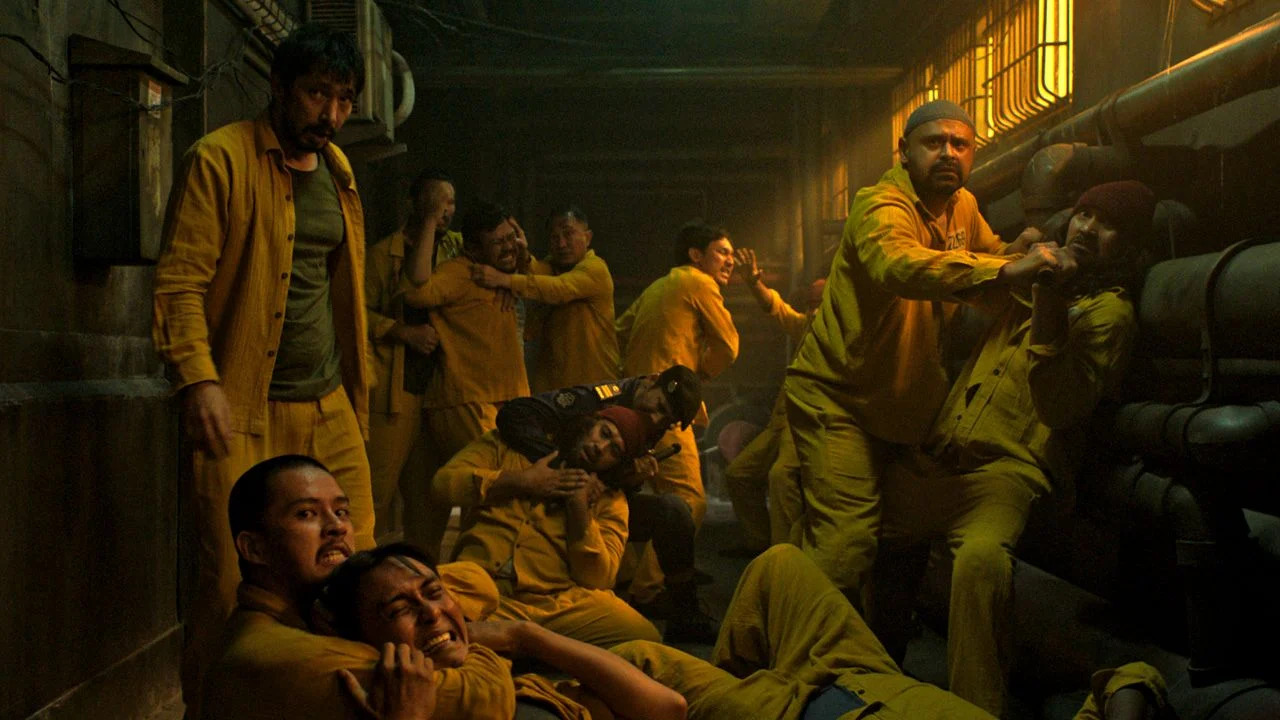
Ghost in the Cell, for the most part, is a film that can teach us something about aesthetic commitment. At its core are these elements that otherwise would not have worked cohesively: that brand of Indonesian cinematic violence, slapstick, Indonesian horror, and social commentary. It has everything that is present in popular Indonesian cinema, so how should it commit to everything? By leveling the other aspects of its form.
Prison as a setting is meant to flatten the visuals: actors wearing the same costume, sets almost uniform, limited mobility. The thematic mess is controlled at the level of form. Conceptually, of course, the prison is not a great equalizer. But as a space of extreme power struggle, the mission of a social commentary becomes inevitable. It is in this inevitability that its comedic aspect compliments the gravity of what it aims to comment on. Great performers doing caricature made it easier to compress the complexity of their characters: from a failed robber who was wronged by a landlord in Abimana Aryasatya’s Anggoro, Rio Dewanto’s Endy who have decided to be the right hand guy of the most powerful prisoner in the block to lessen the killings, Magistus Miftah’s Novilham whose agony over his displacement due to corrupt political practices was expressed in his dance, even with Bront Palarae’s insecure prison guard demanding for some respect.
The limitations, however, of this appealing to popular forms lead its social commentary to also appeal towards popular sentiments as its recommendation, specifically, spiritual ones. Joko Anwar, thankfully, is bright enough to address this with humor without the posturing of an enlightened bourgeois. Its suggestion of a spiritual reawakening in the midst of injustice, whether through religion or through art, is presented considering also their limitations. Religion places importance to the grandeur of the ritual that it tends to dismiss those that it meant to protect. Art, on the other hand, does not automatically heal the soul if the wound is too concrete to ignore.
What led to its resolution is that scene where the camera tracks the prison block and every person in the cell either prays, dances, or sings: to bring religion out of the church, and art outside of the studios. What mattered was the consistency of practice, so when the time comes to take matters into your hands, the action is guided by spiritual enlightenment, violence for justice becomes meaningful.
But what, in the end, made the film’s conclusion very limiting is similar to how Grave Torture considered justice as self-destruction. A wishful thinking of death coming to the corrupt because of their own evil and not because of an active pursuit for justice and fairness. It may be a culturally specific thought that, unfortunately, does not translate really well across if what it meant is just karmic poetic justice. If it is meant to scare anyone, it does not really help rooting for the murderous ghost to do its thing. It is not even fascinating if we consider the gravity of the actions of the corrupt in the context of the movie. Again, perhaps, that’s part of its commitment to the popular forms it took: the fights are great, the macabre looks good, the plot is compelling, and the messaging is there. But it can only commit also to the limitations of its popular imagination.
Leave a Reply