
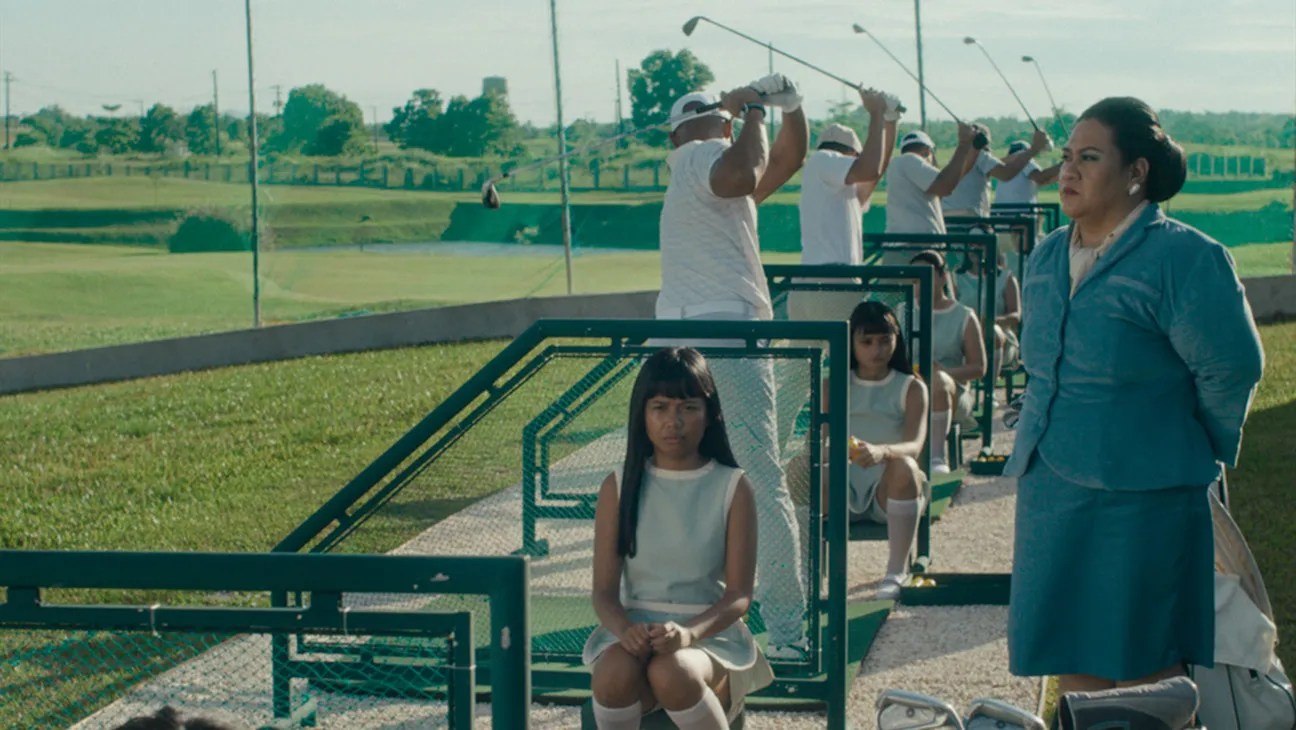
Filipiñana depends its cinematic development in the conceit of diplomacy. I think it is one of those few works that succeeded in being deliberately open for interpretation. That to argue any which way, or from any vantage point that we judge the film, presents a “success” in its mission. The liberal’s escapist fantasy of irreducibility of debate into sides, the delusion of the middle ground. It is not that it does not lean toward any side of its own discourse. If anything, the movie exposes its position by setting its own gaze in this way.
Let me just frame my argument first: during the height of the cold war, the United States, through the Office of the Strategic Services (predecessor to the Central Intelligence Agency), flooded the intelligentsia with resources to muddle the discursive arena with endless debates about which direction the world was going. Through a non-government front Congress of Cultural Freedom, the OSS sponsored platforms and publications to bring forth these endless debates, turning this discursive openness into an ideology that they tried to package as “democracy.” The point was never really to actively promote American imperialism on the nose, but rather to popularize non-positionality. The pre-requisite to be bankrolled by imperialists is to show that you stand in the middle. It is only in this openness that the imposition of imperialist interest become relevant in its pretense to be one of the choices among several.
The Philippines is not a stranger to its own people being accomplices to imperialist interests. Philippine cinema, in the least, gave a little extra and explicitly went pro-American in its movies, from Fernando Poe, Jr. to Lamberto Avellana. Edward Lansdale had a direct hand in this, as the contemporary popular sentiments go, the Philippines became the guinea pig for any counterinsurgency campaign on both military and cultural fronts. This left the literati in a different position: the war of hearts and minds in the pen positioned itself as a platform for the debate, as they say, to “keep the conversation going.” Literary journals were funded both for platforming support and for dissuading anti-imperialism. Still, working as an accomplice to further sharpen the class divide: the popular masses are drowned by the red scare while being scared by militarization into surrender, while the middle-class intelligentsia is being deluded to believe that being enlightened means to endlessly talk about issues and struggles.
The cold war ended, but what it left in the cultural sphere never went away. We see even after the Marcos dictatorship, proclamations of non-positionality as an enlightened position, and expressions of kinship or political leaning as extremism. This dissuaded developments within the nationalist line as irrational, abandoning it as a project for the neoliberal delusions of globalization. At this point, declarations of the end of history are celebrated at the same time as the cynicism of the so-called Generation X becomes a dominant cultural expression, sharing their cowardice as a way of life.
Within this context, you find Filipiñana as simultaneously an asset and a victim of imperialism. An asset does not need to be conscious of being commissioned, for as long as it operates smoothly within the apparatus, it is sure to reap the positive benefits of its actions. A victim in the context of the asset, while fundamentally coming from its non-knowledge of being commissioned, is trapped within the limitations of what can be done within the very logic of the system it is being subjected to. This is what lies behind Mark Fisher’s criticism of the “alternative scene” being the expression of the logic of the mainstream through its apparent negation. The film as an operative of the state apparatus exposes its modus in its form.
What can be first observed in Filipiñana is its choice of mise en scene: the landscape overwhelms humans and is shot wide with infinite focal points. There is nothing that you can’t see. The golf course is the protagonist, the tiny moving meat puppets provide its character. The vastness and cleanliness of the land make it seem that it is anywhere in the world but the Philippines. What gave it its Filipino-ness are the things that face tourists: folk songs performed by a string band, the dance, the fiesta, and the lie (according to Red Ollero) that is “Mabuhay.” (The film’s lukewarm treatment of the Chinese will make the xenophobic soul of Mike de Leon sad.)
We combine this visual accessibility, this capacity to see everything clearly, with a performance treatment borrowed from one of those approaches in Western modernist theatre: dead pan acting, synchronized movement of the ensemble, and a hostile attitude towards the audience.
According to the synopsis, Isabel follows Dr. Palanca because she was mysteriously attracted to him. The choice of the dead pan already betrays this premise. Expression of interest in someone is an affection that is best conveyed visually through an explicitly expressive approach. The stylistic treatment does not allow Jorrybell Agoto to perform that. Filipiñana’s dead pan extremism demands of its performers a blank stare and a monotonous tone. Whether or not the film effectively communicates what it wants to communicate – like Isabel’s interest in Dr. Palanca – is something that is left for the audience to decide. This is a parcel of the film’s conceit. If the treatment confuses you, makes you think otherwise, it will be its success. Whatever your decision is will be entirely your fault.
Shots where the masses of workers perform their duties in unison, in rhythmic precision are no less an applaudable feat in choreography where the directorial vision depends on. We are forced to contrast this with that one sequence where the bourgeois dance merrily without a care for the beat. This rehashes the tired petitbourgeois dichotomy between labor and leisure that aligns them with routine and pleasure respectively. The rhythmic sways of golf course janitors, while themselves choreographed patterns, are presented as monotonous gestures, reducing collective labor to cold efficiency.
If we take in both the dead pan approach and the coldness of repetitive labor, it is not surprising that at some point you will capture an uneasy feeling that is directed at somewhere. At first, due to its conceit of diplomacy, you will deny it but eventually find yourself being targeted by something sinister. The film’s conceit of diplomacy forces you to take the perceived coldness as your own. You take notice of the extremes in depictions of the characters.
It is understandable how, for example, in Bertholt Brecht’s theatre, characters are reduced to caricatures because the immediacy of complex messaging (of war, capitalism, science) demands an uncomplicated channel. Filipiñana attempted to play with those caricatures too: the bourgeoisie as expressive individuals who are happy, singing, and are frustrated at times: full human beings; while the workers are dull, look the same, sound the same as they talk about the interesting lives of their bosses. But we can’t say that the message is complicated. The bourgeois counterpart that we are following, Clara (Carmen Castellanos) is this typical young adult who seems lost, like a protagonist from a burgis indie film. And like those indie protagonists, their ennui does not come from anywhere complicated but their privilege. That much is upfront to us. Castellanos plays the role of the indecisive diasporic juvenile really well by looking so confused in every single frame, like the Philippines is beyond her understanding.
As mentioned above, Jorrybell Agoto’s Isabel, treated with deadpan, becomes this litmus test for sympathy. If we believe that she’s interested in Dr. Palanca, we need to follow her to see what her reason is. And if we believe her monologue as her motivation, we must do so with full understanding of what she decisively does as completely justifiable, despite her doing it with a blank stare.
The film’s static frames never repeat, making our perspective limited despite having to see everything in the landscape of infinite focal points. The choices of frames deliberately avoid suture of perspective, forcing its audience at a distance. And by the time it decides to frame Isabel’s view point for the last time as we hear her inner monologue, we are already too far, and perhaps, have dozed off, too asleep to care. At that point, the ball is already in our court, the audience. The film cuts away the moment Isabel raises the golf club. Whether she killed Dr. Palanca as an act of vendetta or not is something that the film left for the audience to decide. After all, what is missing from the deadpan is for the audience to fill in.
This moment that it leaves the audience to decide is, I think, a very hostile moment. Its diplomacy is a conceit that blackmails its spectators into witnessing a cover up and the denial of revolutionary justice. The most ridiculous thing of all is that this cover up is merely suggested; and at that point we are just as shocked as Clara, but now we are the confused ones.
What Filipiñana ultimately expresses is not the self-critical look against the ruling classes that its earlier commentators seem to capture. It does not exude an “eat the rich” attitude. It does not hold a candle to the decisiveness of Nocebo, despite its precolonial fantasy. It is not an apology, but rather an expression of shame that is rather shared perversely. The enjoyment of the colorful golf course with eyes that similarly see the working class as a lump of mechanical mass, who are occasionally murderous, is a perspective it gladly forces on us.
The last scene as the credits roll, where Isabel shouts for help is the first time we see her coming out of the dead pan treatment. Isabel shouts at the fourth wall, but our perspective remains still as we see her disappear. This scene reminds me of how Dennis Marasigan’s film adaptation of Malou Jacob’s Anatomiya ng Korupsyon ended. Cely (Maricar Reyes) rather whispers cries for help as her idealism crumbles against the wall of bureaucratic corruption. Isabel’s shout for help is placed at the mercy of the film’s conceit of diplomacy, leaving us to decide what it means. But imagine that scene being watched at an international film festival, where the audience applauds at the same time because the credits also roll as we see Isabel drown. While Cely’s cry for help in Anatomiya ng Korupsyon signals a break, our point of view as Isabel disappears into the water finalizes the audience’s complicity. Filipiñana’s faux-diplomacy is its self-loathing cowardice that forces its spectator to become a traitor (I apologize Comrade Fanon for paraphrasing).
Leave a Reply