
I was able to catch this year’s MCinelikha Film Festival held inside the Miriam College campus as part of an official office function. Not that I am complaining, it’s great to have those from time to time. This year’s theme “Ascend” seems to reflect very subtly with this year’s selection of films. Reflecting on values of truth, peace, justice, and integrity, as their festival statement said, seems to reflect roughly through the selection, but given the milieu, especially outside the campuses, it might be understandable why it is so.
The festival opens with a screening of a guest film, Agapito, produced by a Miriam alumnus, Kristine de Leon. It is probably the third time I have seen the film. Arvin Belarmino and Kyla Romero shifted a murky duckpin alley to a fantasy merger of semi-proletanization and performance art. Knowing how the film will be, I kind of felt gloomy on how the programming will go.
Agapito is followed by a brief talk by producer de Leon who has shared to the audience the “mistakes” she made when she was starting in the “film industry.”
The main program consists of three films made by Miriam College undergraduates who are quite obviously testing things out on their own, maybe for the first time. Lapses are expected here and there (all of which are fixable by a second pass in the post-production work). Our generosity is granted to the material the kids prepared for their audience. Looking back, the only question I asked myself is, “are the kids alright?”
We Were Here, directed by Erika de Guzman, opened the main competition program. Penned by Lyka Tanabis is a draft of an afterlife fantasy grounded on a halted romance. What made this very interesting is that it is frustration, not heartbreak, that drives this push towards the fantasy. Its overall tone was never explicitly painful nor was it bittersweet. The film’s obsession with continuity cuts makes it so that its discourse of the afterlife is where the flow of the stymied love progresses.
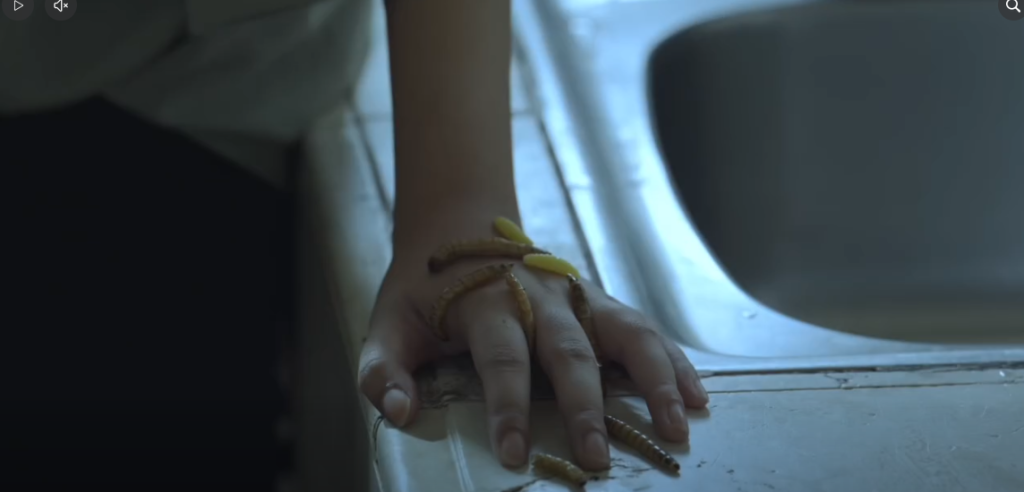
The technically polished Insekto follows as the second film. Completely different in theme and approach, director Krishna Bruno places a girl (wonderfully performed by Guillana Tagle) into a labyrinth of memory, trying to untangle where things went wrong. Everything seems to me an anxious glimpse of an unfixable crumbling state in the guise of a house.
Mika Santelices’ Anit raises the stake of what can a short film be with an ensemble cast webbing and weaving narratives to interrogate the essence of being a woman and what can a community do to help construct this essence. Perhaps the only glimpse of optimism that afternoon that would easily make anyone feel at ease. Expectedly, the festival awarded the film with almost all the awards that they can possibly give.
Interestingly, MCineLikha Film Festival chose to close this year’s leg with an exhibition of Vianca Abuloc’s Anino, a rather rough take on post-traumatic stress. I am not sure how the filmmakers thought of their approach to the subject matter (or what are their thoughts are of the issue), but I find their skepticism over mental health intervention quite interesting. It’s as if suggesting that the pill does not work anymore, but it felt more like a cry for help than a critique.
The afternoon’s programming went from a self-fulfilling accident in Agapito, a crash towards repetition because death is frustration (in We Were Here), an unrepairable loop (in Insekto), a hint of hope and understanding (in Anit), and back to that scar that even doctors can never heal (in Anino). Outside, the roads are getting blazed by a 42 degree-celsius heat index, a prevailing crisis caused by wars within and without, and a regular programming of imperialist plunder and bureaucrat capitalist corruption. Despair within the concrete walls of the schools is understandable. The kids are not alright, but they are doing their best. Yet the heat still burns.
Leave a Reply